New · Prep for the April 2027 MTD change →

Construction finance you can build on.

CIS, VAT, payroll, tax and cashflow handled as one connected system, by Chartered advisers who understand retentions, reverse charge, subcontractors and the way construction money actually moves.
600+ UK businesses
Fixed monthly fees
PREMIUM Software included
Every finance function, compliance and insight, synchronized intelligently into one ecosystem.
Logo of Telleroo
Logo of Stripe
Syft company logo featuring a stylized blue 'S' with the word 'Syft' in black text.
GoCardless logo with bold black text on a light green background.
QuickBooks logo
AutoEntry company logo with red eye symbol above the blue text.
Black stylized text spelling 'apron' with a period at the end.
Fathom company logo with stylized blue and teal geometric shapes.
Power BI logo with a yellow bar chart icon and text.
Telleroo logo with a blue dot at the end.
Stripe company logo in blue lowercase letters.
Syft company logo with stylized blue 'S' and black text.
GoCardless wordmark logo in black on a yellow background.
QuickBooks logo.
AutoEntry logo featuring a red stylized eye above the word 'AutoEntry' in blue text.
Apron brand logo in bold lowercase letters with a period.
Fathom brand logo
Microsoft Power BI logo in yellow with stacked bars icon.
Construction finance looks different depending on which side of the payment you sit.Start where you are
01

I’m paid under CIS

Check whether you have overpaid, what you can claim, how MTD affects you and whether your current structure still makes sense.
02

I pay subcontractors

Get verification, deductions, monthly returns, records and gross-payment-status controls running properly before HMRC has a reason to ask.
03

I run projects, developments or SPVs

Connect CIS, VAT, project margins, retentions, cashflow and finance leadership instead of solving each one separately.

See how much of CIS you could claim back from HMRC.

CIS is deducted before your actual expenses and allowances are known. Add a few numbers for an indicative view of whether you may have overpaid.
elixir-tax.com/cis-estimator
Your work only. Leave out materials.
£
Not subject to CIS deduction. Enter 0 if none.
£
Tools, van, fuel, materials you buy, insurance, phone.
£
Estimated position this year
£2,312
Likely refund. HMRC took more than your actual bill.
CIS taken at source (20%)
−£9,600
Allowable expenses
−£7,400
Taxable profit
£40,600
Income tax
£5,606
Class 4 NIC
£1,682
Tax actually due
£7,288
See your full breakdown
The line-by-line figures and your gross-status comparison. No spam, just your numbers.
With gross payment status, you would keep £9,600 in your cashflow across the year instead of waiting to reclaim it. We apply for it and protect it.
Labour element only, across all subbies.
£
Your work only. Leave out materials.
£
CIS to deduct and remit each month
£3,600
Due to HMRC by the 22nd, with a CIS300 return every month.
Labour paid to subbies / month
£18,000
Deduction rate
20%
Subcontractors to verify
6
Deduct and remit / month
£3,600
Passing through HMRC / year
£43,200
See your full breakdown
The line-by-line figures and your gross-status comparison. No spam, just your numbers.
Every one of those subbies needs verifying before payment. Skip it and HMRC can force 30%, with the liability landing on you.
Thank you! Your submission has been received!
Oops! Something went wrong while submitting the form.

Indicative estimate for self-employed subcontractors and contractors, based on 2025/26 rates (personal allowance £12,570, basic rate 20%, Class 4 NIC 6% / 2%). Not a tax computation. Limited company positions, CGT, VAT and reliefs are handled in a full review.

Where CIS quietly breaks

The return is usually where a CIS mistake appears. Not where it starts.

Almost 70% of CIS penalties happen between the steps, not at them. Most CIS problems begin earlier, in status, verification, the deduction calculation, records or timing. We control those steps before the monthly return is built.This is the map HMRC works from. We work from it first.
01

Register before the first payment

CIS should be considered before subcontractor payments begin, not reconstructed once several months have already passed.
02

Verify the business you actually pay

The identity, UTR and legal entity need to match the subcontractor receiving the money. Familiarity is not verification.
03

Get the deduction base right

The rate is only half the calculation. Labour, qualifying materials and other costs need to be treated correctly before the percentage is applied.
04

Keep the monthly rhythm boring

Verification, returns, statements & payments work best as a routine. Repeated small lapses are harder to defend than 
one clearly corrected mistake.
05

Keep the evidence with the payment

Invoices, verification records, statements and decisions should be retrievable without rebuilding the story from emails six months later.
The point most firms miss: For businesses with gross payment status, compliance is also a working-capital issue. If gross status is withdrawn, deductions can return to qualifying payments and cash that used to arrive in your bank stays elsewhere instead. We monitor the position before a compliance problem becomes a cashflow problem.
Everything, under one roof

Built for how construction money actually moves.

From the first subcontractor payment to the final retention, one team keeps compliance, tax, reporting and cashflow connected.

CIS & contractor compliance

Status, verification, deductions, statements and monthly returns handled before payment, not reconstructed afterwards.
✓ Subcontractor verification before every payment
✓ Monthly CIS300 returns and deduction statements
✓ Gross payment status applied for and protected
✓ Deemed contractor monitoring against the £3m threshold

Virtual CFO & Business Intelligence

Know which jobs make money, where cash is trapped and what the next few months look like before the bank balance tells you.

Making Tax Digital

Digital records and quarterly reporting built into the finance system you already use, rather than added as another piece of admin beside it.

Tax , Structure & Strategy

We connect sole trader and company decisions, property structures, SPVs, VAT, capital allowances and longer-term tax planning instead of treating them as separate conversations.

Financial operations

Bookkeeping, payroll, VAT and year-end accounting kept current enough to run the business from, not merely clean enough to file later.

Not sure what you  actually need?

Tell us how you trade, who you pay and where the finance currently gets messy. We will show you the setup that fits.
Your stack, connected

One finance function, every system in sync.

We connect accounting, payroll, CIS, payments and reporting so information travels once and remains useful from the transaction to the management decision.

Xero

Live bookkeeping and bank feeds
CIS and VAT returns filed from source

Sage

Payroll with CIS and PAYE together
MTD-ready digital records

QuickBooks

Job costing and project tracking
Reconciled to the penny each month

Stripe

Payments reconciled automatically
Fees and VAT handled correctly

Fathom

Profitability dashboards by project
Cashflow forecasting across retentions

+ your current stack

Dext, Power BI, GoCardless and more
We map to what you already use
Your compliance calendar

Dates worth putting on the wall.

CIS runs monthly. Tax follows its own timetable. MTD adds a quarterly reporting rhythm for eligible sole traders. We connect the deadlines to the money sitting behind them.
19th monthly

CIS return and statements

Your CIS300 filed and deduction statements issued to every subcontractor for the tax month.
22nd monthly

CIS and PAYE paid to HMRC

Deductions remitted electronically. Miss it and interest and late-filing penalties start to build.
31 Jan 2027

Self Assessment and your MTD trigger

For sole traders potentially entering MTD from April 2027, the qualifying income reported for 2025/26 is particularly important. Online return filed, balancing payment and first payment on account due. This is also the return HMRC reads to decide who joins MTD in April.
6 Aprl 2027

MTD for Income Tax drops to £30,000

The threshold falls from £50,000 to £30,000, pulling in a whole tier of subcontractors. It falls again to £20,000 in April 2028. The prep starts now, not in the spring.
7 May · Aug
Nov · Feb

MTD quarterly updates

Once you are in, four digital updates a year replace the old once-a-year scramble. We file them for you.
31 Jul 2027

Second payment on account

The mid-year instalment toward next year's bill. We plan cashflow around it so it never lands as a surprise.

Not sure which of these apply to you?

Check my MTD position with us and we can tell you whether the April 2027 rules are likely to apply, what needs changing and what can stay exactly as it is.
Book your free 30 minutes slot
Fixed fee · no surprises

Pricing shaped around where you sit.

Pick the level that matches how you work. Every plan is a fixed monthly fee with software included and a named person to call.
Subcontractor · sole trader

On the tools

£34/mo
from, ex VAT · billed monthly
✓ Self Assessment prepared and filed
✓ CIS refund reclaimed in full
✓ Expenses reviewed so nothing is missed
✓ MTD-ready digital records
✓Bookkeeping software included
Most chosen by contracters
Contractor · limited company

Running the site

£119/mo
from, ex VAT · billed monthly
✓ Everything in On the tools, plus:
✓ Monthly CIS300 returns and verification
✓ Payroll with CIS and PAYE together
✓ VAT returns with reverse charge handled
✓ Year-end accounts and corporation tax
✓ Gross status protected and monitored
Developer · growing firm

Building the business

£345/mo
from, ex VAT · billed monthly
✓ Everything in Running the site, plus:
✓ Virtual CFO on call
✓ Project profitability dashboards
✓ Cashflow forecasting across retentions
✓ Tax structuring for growth and exit
✓ Quarterly strategy reviews
Figures are starting points and scale with the work. Book a call for a fixed quote against your actual turnover, subbie count and filing load.
Free CIS Field guide

See the weak points before HMRC asks about them.

A practical 70+ page guide to the parts of CIS that are easiest to get almost right: verification, records, deductions, gross payment status, deemed-contractor exposure and the controls that make your position easier to defend.

Inside, you will find the recurring CIS failure points, the contractor intelligence checklist, the controls behind a defensible CIS process and a practical way to assess where your current setup is vulnerable.
✓ The ten errors that cost contractors the most
✓ The deemed contractor trap most firms never see coming
✓ The full CIS Intelligence Checklist
Thank you! Your submission has been received!
Oops! Something went wrong while submitting the form.
How we help you get there

A cleaner finance setup, in four moves.
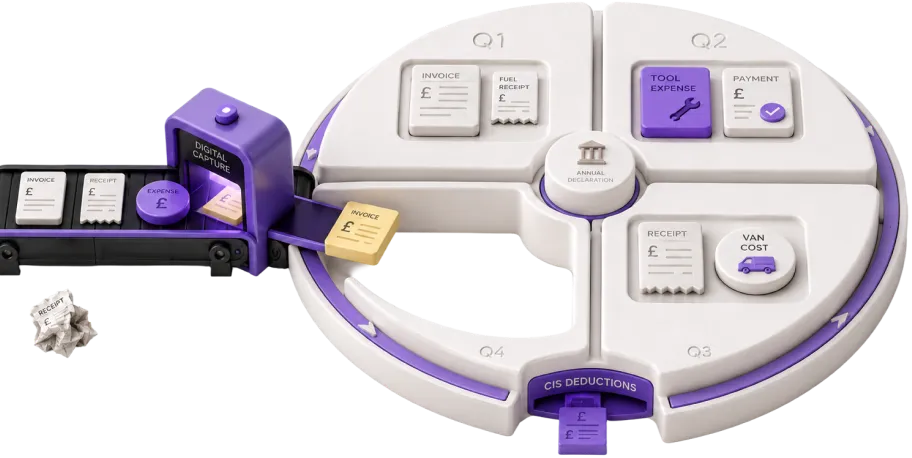
01

Review what exists

A deep look at your current CIS, tax, payroll, VAT, records, software and finance routines to understand what is working and what is exposed.
02

Fix the weak points

Registrations, records, data, workflows and responsibilities are cleaned up before we add more complexity.
03

Run the recurring work

We take over the agreed bookkeeping, returns, payroll, CIS and finance routines so compliance becomes part of normal operations.
04

Keep looking ahead

Regular reviews keep tax, cashflow, structure and reporting aligned as the business, projects and rules change.

... is super efficient and friendly

Our company’s year end accounts and my self assessment completed in timely manners. Elixir accountancy is super efficient and friendly. Thanks to Idrees and his team.

Talha Jawad

...they help you regardless of your situation and time restraints

Elixir has continued to support myself and my business through thick and thin. Not a money-grabbing company, they help you regardless of your situation and time restraints. I've never questioned their accounting skills, always accurate, prompt, polite, flexible and great communication.

Tom Stringer

...am never using anyone else in future. I can wholeheartedly recommend

Idrees completed my last 4 years of tax return. He completed everything on time and with exceptionally high level of professionalism. Idrees was always available to answer all my questions. He is very knowledgeable and explains the tax system really well. I have used many other accountants for my tax return before meeting Idrees. I am never using anyone else in future. I can wholeheartedly recommend Idrees to everyone.

Saydul Bashar

...have been impressed by the expert knowledge and the readiness to clarify any questions I had

Thank you Elixir Chartered Accountants for their professional support with my business accounts as well as the accounts for my second business and my personal tax return. I have been impressed by the expert knowledge and the readiness to clarify any questions I had, and by the speed with which all the accounts and returns were prepared.

Nancy Clay

... we always find them to be professional , friendly and highly qualified,

As a company, we have been soliciting the help of this accountancy firm in particular Idrees for nearly 5 years, we always find them to be professional , friendly and highly qualified, would highly recommend

Hassan Gholizadeh

... we’ve gone from week-late reporting to real-time insight at our fingertips

We run multiple medical clinics and we were overwhelmed by information across multiple branches and had no clear view of staff utilisation. Elixir integrated our data and built a Power BI dashboard platform that delivered real-time financial data, interactive dashboards, and automated anomaly alerts, all from a single source of truth. Management can instantly see branch profitability, cash flow, and key KPIs. We’ve gone from week-late reporting to real-time insight at our fingertips.

Dr Sundeep Soin

What is the Construction Industry Scheme (CIS)?

CIS is how HMRC collects tax at source in UK construction. When a contractor pays a subcontractor for construction work, they deduct tax from the labour element and pass it to HMRC. The subcontractor then reclaims it through their return. It applies to most building, civil, electrical, plumbing, roofing, groundwork and finishing work.

Why is 20% or 30% taken off my payments?

Registered subcontractors have 20% deducted from labour. If you are not registered with HMRC for CIS, the rate jumps to 30%. Only labour is deducted, not materials or VAT. Registering is quick and drops you to 20%, so it is worth doing before your next payment.

Am I owed a CIS refund?


Often, yes. CIS is taken off your gross labour before your expenses and personal allowance are counted. Once your real tax bill is worked out, the tax already deducted is frequently more than you owe. That gap comes back as a refund. Our estimator above gives you a first read, and we reclaim the full amount when we prepare your return.

How do I get gross payment status?

You need to pass three tests: a turnover test (£30,000 of labour turnover per director or partner, or £100,000 across the business), a compliance test on your tax history, and a business test. Once granted, you are paid in full with no deduction, which transforms cashflow. We apply for it and then protect it, because it is withdrawn for patterns across CIS, PAYE and VAT, not single mistakes.

Do I charge VAT or does the reverse charge apply?

Since March 2021, most CIS-registered construction services between VAT-registered businesses fall under the domestic reverse charge. The customer accounts for the VAT, not you. Getting this wrong is a common and expensive error. We set your invoicing and returns up so it is applied correctly every time.

Could my business be a deemed contractor without knowing?

If a business spends more than £3m on construction in a rolling twelve months, it becomes a deemed contractor and takes on full CIS obligations, even if construction is not its main trade. Property investors, retail chains and developers using SPVs get caught by this. We monitor the threshold so it never becomes a backdated bill.

Does Making Tax Digital affect subcontractors?

Yes, and the next wave is the one that catches most of construction. The £50,000 threshold has applied since 6 April 2026. From 6 April 2027 it drops to £30,000, and to £20,000 from April 2028, which pulls in most working subcontractors. HMRC decides from the income on your 2025/26 return, due by 31 January 2027, so the groundwork starts now. We get your records digital and that return clean, then handle the quarterly updates (7 August, 7 November, 7 February and 7 May) so April 2027 is a non-event rather than a deadline.

Let's get your CIS in order.

A short call, a clear picture, a fixed fee. That is the whole start.
info@elixir-tax.co.uk
01252 929786
Aldershot, Hampshire

Resources

VIEW ALL  >

HMRC Automatic MTD Sign-Up: What Happens Next?

From September 2026, HMRC began signing up some sole traders and landlords who should already be using Making Tax Digital for Income Tax but had not registered themselves. Automatic sign-up is not automatic compliance. HMRC may have created the MTD record, but the taxpayer must still check the income sources HMRC holds, choose and authorise compatible software, recreate digital records from the start of the tax year, send overdue quarterly updates and continue towards the year-end tax return. This guide explains what HMRC's action means, what it does not mean, and how to put the position in order without turning a late start into a long-term records problem.
BLOGS
Making Tax Digital (MTD)
SMEFinance
Cloud Accounting Software

The Shadow Spreadsheet: Why Your Team Trusts a Side File More Than Your Accounts

When your team says "that's what Xero says, but the real numbers are in this spreadsheet", you don't have a spreadsheet problem. You have a trust problem. This post explains where shadow spreadsheets come from, the hidden risks they create for UK SMEs, and how to make them unnecessary.
BLOGS
Cloud Accounting Software
Making Tax Digital (MTD)

Why Your Business Enters the Same Sale Six Times & What It's Costing You

In many UK SMEs, a single sale gets manually entered into six or more separate systems. Each entry is a chance for an error and those errors compound. This post explains why human beings make poor middleware, what the rekeying problem actually costs, and what integrated systems do instead.
BLOGS
Digital Record Keeping
Making Tax Digital (MTD)
Cloud Accounting Software